Neodymium Magnets: The Strongest Permanent Magnets for Industrial Applications

Shop Neodymium Magnets by Shape

Rochester Magnet stocks and sources neodymium magnets in discs, rings, and blocks, from small magnets for prototyping to large magnets for production runs. Standard grade N35 nickel-plated stock ships from inventory, with higher grades, high-temperature ratings, and custom dimensions available by request. No order is too large or too small.

Disc and Cylinder Magnets

Round neodymium magnets identified by diameter and height (a 0.500″ x 0.125″ disc is 0.500″ in diameter and 0.125″ tall). Magnetized through the thickness unless specified otherwise. The most common shape for closures, sensors, and holding applications.

Ring Magnets

Round neodymium magnets with a center hole, specified by outside diameter, inside diameter, and thickness. Used in motors, speakers, sensors, and shaft-mounted assemblies. Magnetized through the thickness unless specified otherwise.

Block and Rectangle Magnets

Square and rectangular neodymium magnets specified by length, width, and thickness. Used in motor assemblies, fixtures, and industrial holding applications. Magnetized through the thickness unless specified otherwise.

Adhesive-Backed Neodymium Discs

Neodymium discs with pre-applied adhesive for fast installation in packaging closures, point of sale fixtures, and assembly applications. Available with adhesive on the north or south face for proper magnet-to-magnet alignment.

Get A Quote Now

Simply complete and submit the online form below and we’ll review your specs and contact you with any questions.


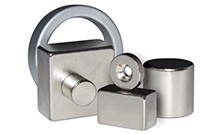
    Neodymium rare earth magnets in disc, ring, and block shapes

    What Are Neodymium Magnets?

    Neodymium magnets, also called NdFeB magnets, are permanent magnets made from an alloy of neodymium, iron, and boron. They belong to the rare earth magnet family and produce the strongest magnetic field of any commercially available permanent magnet. A small neodymium disc can hold many times its own weight, which is why engineers reach for them whenever high strength is needed in a compact form.

    The element neodymium was discovered in 1885, but the magnet itself wasn’t invented until the early 1980s. Each magnet is made by melting or pressing pure metal alloys of neodymium, boron, and iron under high pressure. Melted and sintered material produces the highest-energy magnets, while a powdered bonded form supports complex molded shapes at lower energy levels.

    Among all permanent magnets, it offers the greatest power-to-weight ratio and more lift for its size than samarium cobalt or ceramic. Since the late 20th century, neodymium has been central to miniaturizing electronics like cellphones, microphones, and speakers.

    Neodymium Magnet Strength and Grades

    The strength of a neodymium magnet is expressed as a grade, written as the letter N followed by a number (for example, N35 or N52). The number indicates the maximum energy product measured in Mega Gauss Oersteds (MGOe). A higher number means a stronger magnet.

    • N35 is the most commonly stocked grade and covers a broad range of applications. It provides strong resistance to demagnetization at ambient temperatures.
    • N42 and N52 pack more energy into the same physical footprint, useful when maximum pull force is required in the smallest possible size. N52 is the strongest standard grade available.

    Standard neodymium grades begin to lose magnetization above 176°F (80°C). For applications involving heat, high-temperature grades carry an additional letter designation (H, SH, UH, EH, M, TH) that indicates a higher maximum operating temperature. If your application runs warm, specify a high-temperature grade so the magnet maintains its strength under load.

    For applications that require thermal stability beyond what high-temperature neodymium can provide, Samarium Cobalt is the alternative rare earth option. Our team can help you weigh strength, temperature, size, and cost to land on the right grade.

    Pull Force and Performance

    Pull force is the amount of weight a magnet can hold against a flat steel surface in direct contact. Several factors determine the pull force you’ll see in practice:

    • Grade: Higher grades produce more pull force at the same size.
    • Size and Geometry: Larger magnets and thicker cross-sections produce stronger fields.
    • Air Gap: Pull force drops sharply as distance increases between the magnet and the steel. Minimizing the gap is the most effective way to maximize hold.
    • Steel Thickness and Condition: A thin, rough, or corroded mating surface reduces pull force compared to thick, clean steel.
    • Coating: Plating adds a thin layer between the magnet and the contact surface, acting as a small air gap. Nickel plating is thin enough that the effect is minimal in most applications.

    Our most popular stock discs are nickel-plated grade N35. For a complete listing of stock sizes with pull force data, contact our engineering staff.

    Neodymium magnets demonstrating strong pull force

    Shape and Size Customization

    Beyond standard discs, rings, and blocks, Rochester Magnet sources custom neodymium magnets to your specifications. Custom options include:

    • Custom Dimensions: Non-standard diameters, thicknesses, and block dimensions produced from your engineered drawings.
    • Custom Shapes: Geometries beyond discs, rings, and blocks for specialized assemblies.
    • Specific Grades: From N35 through N52, plus high-temperature designations.
    • Magnetization Direction: Through-thickness is standard, but diametric and other magnetization patterns are available for sensing, motor, and encoder applications.
    • Coating Selection: Nickel, epoxy, and other protective finishes matched to the operating environment.

    Custom neodymium magnet orders typically take weeks to source and produce rather than months. Share your drawings and performance requirements and our team will quote timelines and pricing.

    Strong neodymium magnets in industrial and commercial use

    Safety and Handling

    The same strength that makes neodymium magnets useful also makes them potentially hazardous if handled carelessly. A few practices keep handling safe:

    • Keep Magnets Separated: Small magnets can shatter when they snap together from a distance, sending fragments outward. Store loose magnets with spacers or separators between them.
    • Slide, Don’t Pull: Large magnets can pinch skin or cause injury if fingers are caught between attracting surfaces. Slide magnets apart rather than pulling them directly off a steel surface or each other.
    • Protect Electronics and Media: Keep neodymium magnets away from hard drives, magnetic stripe cards, and other devices sensitive to magnetic fields. The field can corrupt stored data at close range.
    • Mind Medical Devices: Keep strong magnets away from pacemakers and other implanted medical devices.

    Rochester Magnet can advise on handling procedures and packaging methods for your specific magnets. Let us know if you need guidance on safe integration into your product or process.

    Strong neodymium magnets stored safely with cardboard spacers between each magnet on a workbench

    Industrial and Commercial Applications

    Neodymium magnets are embedded in products and systems across nearly every manufacturing sector. Common applications include:

    • Automotive: Motors, power steering systems, micromotors, and electronic systems rely on neodymium for its high lift power in a compact size.
    • Computers and Electronics: Hard disc drives use neodymium magnets in their read/write mechanisms, and the disc surface itself stores data on billions of tiny magnetic domains.
    • Point of Sale Marketing: Neodymium magnets hang in-store advertisements and enable fast price changes without damaging surfaces.
    • Industrial Equipment: Generators, electric engines, magnetic separators, cordless power tools, couplings, and pumps use neodymium for compact, high-efficiency performance.
    • Everyday Products: Door catches, jewelry clasps, home improvement hardware, and countless consumer goods incorporate commercial neodymium magnets.

    How Neodymium Compares to Other Magnet Types

    Choosing neodymium over another magnet material comes down to the demands of the application.

    Neodymium vs. Ceramic (Ferrite)

    Neodymium produces far more pull force per unit size and weight. Ceramic magnets cost less and resist higher temperatures, which is why they’re often paired with steel armatures in magnetic assemblies to compensate for lower raw strength. Choose neodymium when strength and compactness matter; choose ceramic when cost and temperature resistance are the priorities.

    Neodymium vs. Samarium Cobalt

    Both are rare earth magnets. Neodymium is stronger, more affordable, and more resilient. Samarium cobalt withstands much higher temperatures and resists corrosion naturally. Choose neodymium for ambient-temperature strength and value; choose samarium cobalt for sustained high-heat or corrosive environments.

    Neodymium vs. Alnico

    Alnico handles extreme temperatures (up to about 1,000°F) better than any other common material, but it produces a weaker field and demagnetizes more easily. Choose neodymium for raw strength; choose alnico for high-temperature stability where lower strength is acceptable.

    Order Neodymium Magnets Today

    Whether you need a handful of stock discs for a prototype or a wholesale quantity of custom neodymium magnets for production, Rochester Magnet has the inventory and sourcing relationships to support your project. Our engineering staff is ready to help you select the right grade, shape, and coating for your application.

    Frequently Asked Questions About Neodymium Magnets

    Neodymium magnets that have been partially demagnetized by excessive heat can sometimes be remagnetized to their original strength using specialized equipment, provided the material hasn’t been physically damaged or heated past the point of permanent structural change. For most users, replacing the magnet is more practical than remagnetizing. If you have a large quantity affected, contact our team to discuss options.

    Neodymium magnets stored together don’t lose strength from proximity alone, but they pose a handling hazard because they attract powerfully and can snap together, chip, or pinch. The concern with storage is physical safety and avoiding chipping, not demagnetization. Use spacers and store magnets in arrangements that prevent them from slamming together.

    Machining neodymium is difficult and risky. The material is hard, brittle, and can ignite as fine dust during grinding. It should be machined only by suppliers with the right equipment and safety controls, and typically before final magnetization. Rather than modifying a stock magnet, it’s better to order a custom magnet produced to your required dimensions. Our team can source custom shapes and sizes for your application.

    Related Posts

    Choosing Between N45 and N52 Magnets A Buyer’s Guide

    Choosing Between N45 and N52 Neodymium Magnets: A Buyer’s Guide

    Read the Full Article
    Comparing Standard vs. Lower-Cost Neodymium Magnet Options

    Comparing Standard Versus Lower-Cost Neodymium Magnet Options

    Read the Full Article
    Applications of Custom Neodymium Magnets in Modern Engineering

    Applications of Custom Neodymium Magnets in Modern Engineering

    Read the Full Article