


Permanent magnets hold their magnetic field without a continuous power source and play a major role in much of the equipment that keeps industry running. The industrial uses of permanent magnets are wide and varied, from motors that turn conveyor belts to sensors that confirm when a robotic arm has reached its position. And the applications continue to grow as manufacturers push for smaller parts, tighter tolerances, and more automation.
This guide covers where permanent magnets are used across industrial settings, how the four common magnet materials differ, and what to weigh when specifying a magnet for a new application.
Before we get into specific industries, it helps to understand the jobs permanent magnets do on a plant floor. Most industrial magnetic solutions fall into one of the categories below.
Permanent magnets hold parts in place during machining, welding, and assembly, without clamps or fixtures that require constant manual adjustment. Magnetic chucks and fixtures let operators swap parts faster. Because the magnet needs no power, holding force doesn’t fail during a power outage the way an electromagnetic fixture can. That reliability is a big reason permanent magnets in manufacturing settings have replaced electromagnetic fixtures in many applications over the past two decades.
Robotic end-of-arm tooling often relies on permanent magnets for pick-and-place work, especially with ferrous parts on an assembly line. Magnets are also built into the joints and encoders of robotic arms.
Small, high-strength neodymium components help track position and movement accurately in a compact space. This is one of the more visible applications of neodymium magnets in modern manufacturing. Robotics has grown quickly as an industrial buyer of rare earth magnets.
Because neodymium magnets deliver a strong holding force in a small volume, engineers can shrink motors, sensors, and closures without losing performance. This matters most in consumer electronics and medical devices, where every cubic millimeter counts. It also matters in industrial equipment, where a smaller magnet means a smaller, lighter assembly overall.
Magnetic separators pull ferrous contamination out of bulk material streams before it reaches downstream equipment. This protects machinery in food processing, mining, plastics, and recycling operations. Overhead and inline separators use permanent magnets to run continuously at no electrical cost. That’s a real advantage for high-throughput material-handling lines.
Hall effect sensors and position sensors pair a small permanent magnet with a sensing element. Together, they detect proximity, speed, or rotation without physical contact. You’ll find these sensors in industrial motor controls and in automotive throttle position sensors.
In generators, mechanical motion rotates a coil in a magnetic field to produce electricity. Permanent magnet generators are common in wind turbines and backup power systems.
They don’t need an external excitation current, so the design is simpler and more efficient, especially at the variable speeds typical of wind conditions.
The roles listed above vary by industry. The sectors below are where magnets used in industry today are most established, with real-world examples of permanent magnets from each.
Electric and hybrid vehicles depend on neodymium magnets inside traction motors to convert electrical energy into torque efficiently. Beyond the motor, permanent magnets are used in power steering assist motors, seat and window motors, ABS sensors, and fuel injectors.
As EV production scales, the automotive industry has become one of the largest industrial consumers of rare earth magnets. OEMs are working closely with suppliers to source magnet components that meet tight tolerance and quality requirements.
Hard drives, speakers, microphones, and vibration motors all use small, precise permanent magnets. Neodymium’s strength-to-size ratio makes it the default choice where space is tight. Manufacturers building these components need consistent magnet grade and dimensional tolerance across large production runs. That’s a different sourcing challenge than a one-off industrial project.
Wind turbines are a good permanent magnet example at scale. Direct-drive turbine generators use large neodymium magnet arrays to generate electricity without a gearbox. That reduces maintenance needs on offshore installations, where service access is expensive. Magnetic components also appear in solar tracking motors and in the actuators that adjust panel angle.
MRI machines use large, powerful permanent or superconducting magnets to generate the field needed for imaging. On a smaller scale, permanent magnets are used in pacemakers, hearing aids, surgical instrument guidance, and drug delivery devices.
In these devices, reliability and biocompatibility both matter. Medical device manufacturers typically require tight documentation and traceability for magnet components due to the regulatory environment.
Magnetic separation is one of the more established industrial magnetic solutions. Strong permanent magnets pull ferrous metal out of mixed waste streams so it can be recovered and reused. This improves both recycling yield and the purity of the non-ferrous material left behind. It also runs continuously in high-volume material recovery facilities without added electrical load.
Not every industrial magnet application is a hidden motor component. Flexible magnetic sheet and strip are widely used for resealable packaging closures, for point-of-purchase and retail displays that need to change quickly, and for magnetic signage that can be removed and reapplied without damaging a vehicle or storefront.
This is a large share of the flexible magnet work we produce. It’s also a good reminder that an “industrial magnet” doesn’t just refer to rare earth components buried inside machinery.
Choosing the right material is as important as choosing the right shape or size. Here’s how the four common permanent magnet materials generally compare.
| Material | Relative strength | Typical max temp. | Corrosion resistance | Relative cost | Best suited for |
|---|---|---|---|---|---|
| Neodymium (NdFeB) | Highest available | Lower than the other three; ~80–200°C depending on grade | Low unprotected; usually plated (nickel, zinc, or epoxy) | Highest | Compact, high-force: motors, sensors, magnetic assemblies, electronics |
| Samarium Cobalt (SmCo) | High | Higher than neodymium; commonly rated up to ~300°C | Excellent, naturally corrosion-resistant | High | High heat or corrosive environments: aerospace, defense, high-speed motors |
| Ceramic (Ferrite) | Moderate | Good stability at moderate heat | Good | Lowest | Cost-sensitive, high-volume: separators, loudspeakers, basic holding |
| Alnico | Moderate | Highest of the four; tolerates the most extreme heat | Very good | Moderate to high | High-temperature stability and sensing; more easily demagnetized by opposing fields |
Exact operating temperatures and grade specifications vary by product and should be confirmed against our Technical Magnetic Data & Resources before use in a spec sheet or engineering decision.
Neodymium remains the default for most modern industrial magnet applications because of its strength-to-size ratio. Samarium cobalt and alnico both outperform it in heat. Ceramic remains the practical choice when cost and volume matter more than peak force.
Rochester Magnet’s engineering team can help you specify magnet material, grade, and assembly for your application, from a single prototype to a full production run.
Start with the operating environment: temperature range, exposure to moisture or chemicals, and available space. From there, weigh magnetic strength requirements against cost and production volume. Our team can help work through these factors directly. Request a quote to talk through a specific application.
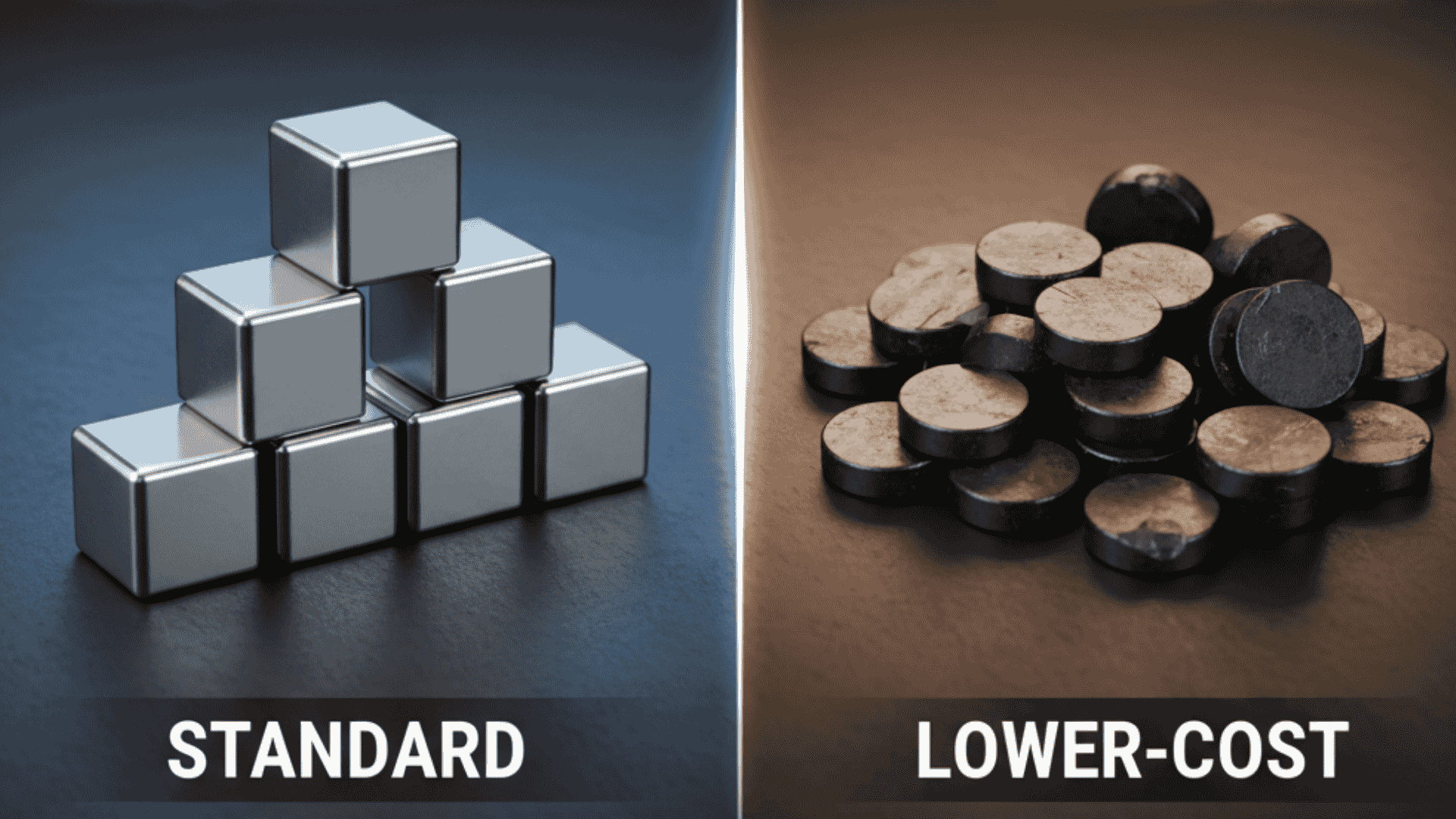



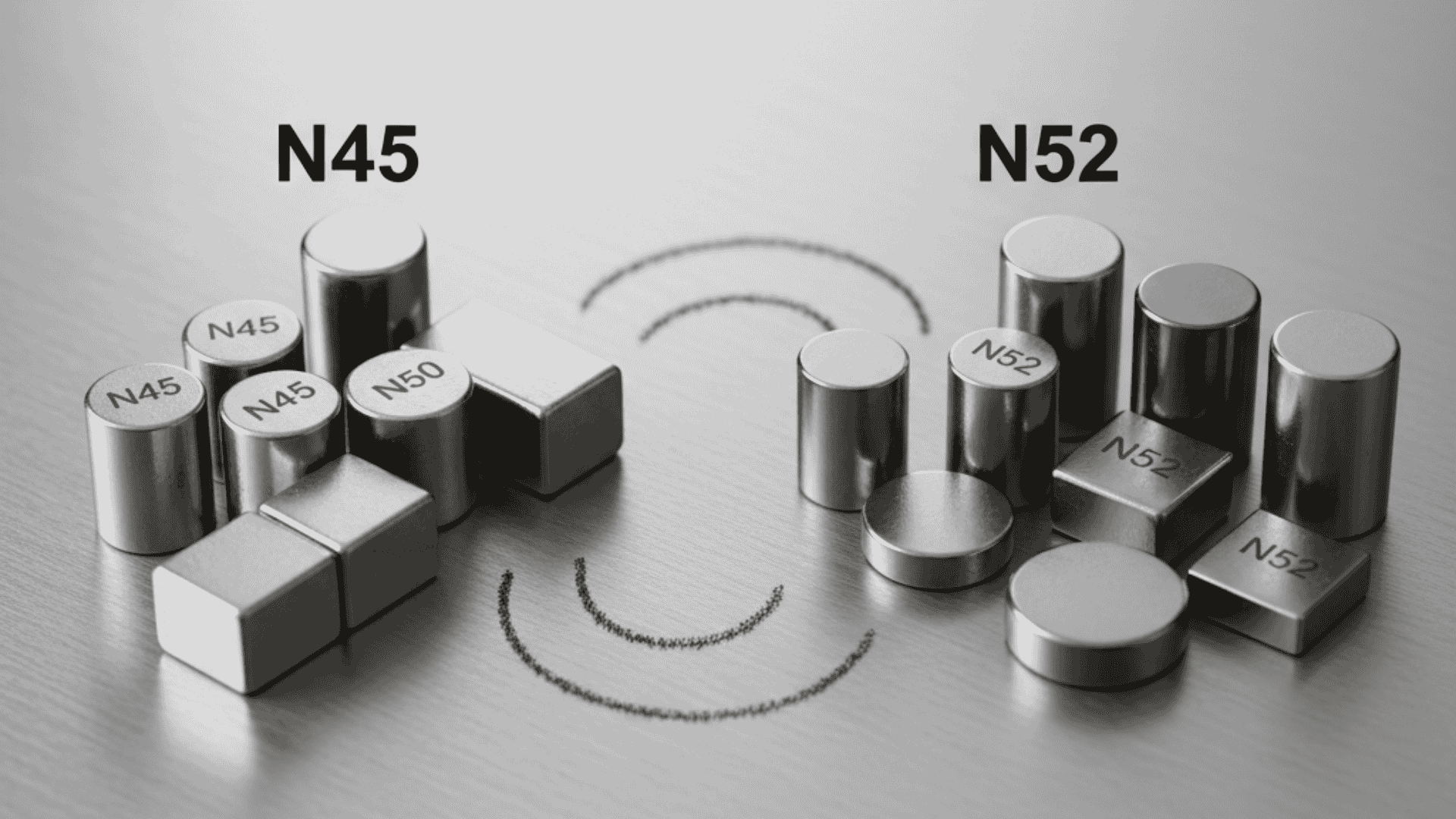
Selecting the right magnet grade is a critical decision for engineers, manufacturers, and product designers. Among the most commonly compared options are N45 and N52

Modern engineering is defined by efficiency, precision, and innovation. As industries push for compact designs, higher performance, and smarter systems, magnetic solutions have become essential
Neodymium magnets have become essential components across industries, from manufacturing and electronics to retail displays and warehouse systems. Known for their exceptional strength and versatility,